Facebook

‏إظهار الرسائل ذات التسميات Adventure. إظهار كافة الرسائل

الاثنين، 17 يناير 2022

Most famous tourist destinations in Baluchistan


Baluchistan is the biggest province of Pakistan consisting up of 44% of its total area, but it is scarcely populated because of which it severely lacks in infrastructure. It is rich in natural beauty, wildlife, mountains and many other resources but due to lack of roads very few of its beautiful locations can be accessed by people. Recently Pakistan government has started to give focus to the tourism industry so we can hope that they will do their part to make these locations accessible to people.

Hanna lake: -

Hanna lake is one of the most famous lake in Baluchistan. It is located 16 kilometers from city of Quetta. Due to easy accessibility many people got there to visit. There is an also a restaurant on the bank ok lake where to can eat under the shadow of huge pine trees. This lake was built by the British in 1890 as a fresh water reservoir. From 2000 -2010 the lake became dry effecting the local wildlife and migratory birds and later in 2011 it was refilled.

Astola island: -

It is small island of 6.7 square kilometer located 39 kilometers from the port of Pasni. It is an inhabited island, its terrain is very tough, its bank is like a steep wall in the sea. Its significance is that it is the only island of Pakistan.

Ziarat

Ziarat city is located in ziarat district,126km away from provincial capital Baluchistan. It has a mountainous region covered in sanober forest. Its climate is cool in summer and is covered in a layer of white snow in winter. It is famous for the Quaid-e-Azam residency where Muhammad Ali Jinnah spend his last two and half month of his life. This place has been turned into a museum; People come here to visit the house to see how Quaid-e-Azam used to live. It also contains the art gallery filled with Jinnah’s and his family rare pictures. Ziarat is also famous for its apple groves and the hospitality that the locals offer.

Gwadar

Gwadar is a coastal city of Baluchistan, Located at the bank of Arabian sea, 650 km away from Karachi. This city is famous for its sea view. It was a neglected region, just in past decade the development started to take pace due to agreement with China for the city development and its port. It has a beautiful coast line. Most famous beaches of Gwadar are hammerhead beach and Turtle beach, whose name came from the turtles that there every year to lay their eggs. Main occupation of locals is fishing, so it is also famous for its local sea food. Pakistan army constructed a cricket stadium in the basin highest peak Mount batil, which was declared as the most beautiful stadium in the world. It is also famous for the Omani forts and boat building facilities.

Hingol National Park: -

It is the Pakistan biggest National Park with the area of 6100 square kilometer. It is home some very rare wildlife and plants unique to hingol. Most unique thing about this national Park is that has six completely different ecosystems, which contains sea, desert, forest mountains, river, streams and vast plains. Apart from that Hingol is famous for it unique rock formations, you can find there a stone looking like a lady standing an looking in the distant named the princess of hope. You can see a naturally formed sphinx from the rock which exactly look like the sphinx in Egypt built by pharos. It is also famous for its kali Mata Mandir which is estimated to be thousands of year old, every year 20000 to 30000 Hindus gather in the center of hangul park to par


السبت، 15 يناير 2022

Bhanbore

Gate of Bhanbore Fort

Situated around 65 km east of Karachi is Banbhore, one of the most captivating and secretive verifiable attractions in Sindh. The site is regularly spelled as "Bambhore" and has played a huge role throughout the entire existence of Islam in South Asia. As per the discoveries of certain history specialists, the site of Bhanbore has the remainders of the old city of Debal or Daybul. It is a similar city where Raja Dahir, an acclaimed Hindu leader of the time, was crushed by the Arab officer Muhammad bin Qasim, who was a gutsy Muslim champion in the Islamic and political history of the subcontinent.

Then again, according to a few other archeological records, the historical backdrop of Bhanbhore has ended up being far more seasoned than the historical backdrop of Islam, tracing all the way back to the primary century BC. Assuming we collect every one of the authentic records together, we reach the resolution that the site was managed by Scytho-Parthian (from first century BC to the second century AD), Hindu-Buddhist (from second century AD to the eighth century AD), and Islamic Rulers in South Asia (from eighth century AD to the thirteenth century AD). There are the remaining parts of an old mosque with an engraving, which is accepted to be north of 1200 years of age. It is found on the eastern side of Bhanbore and is, no doubt, one of the most all around safeguarded instances of the most established mosques in the area.

One of the most unmistakable milestones on the site is a 10-meter tall hill situated close to the shore of Gharo Creek. Bhanbhore once facilitated a completely functional port known as 'Debal Port', which traces all the way back to as old as the middle age time frame. Clearly, the port isn't utilitarian any longer yet its set of experiences actually astounds a many individuals. Since the primary wellspring of the consumable water supply of this old city was River Indus, the destiny of the city was extraordinarily reliant upon the progression of this waterway. Along these lines, when Indus shifted its direction in the thirteenth century, the city was deserted and was never possessed again. The classic story of Sassi and Punnu is likewise connected with this traveler objective in Sindh and it is frequently called "the city of two sweethearts".

Sindh Coastal Highway goes through the city of Bhanbore, making it one of the most effectively available vacation spots in Sindh. Connected with National Highway 5, it is likewise the best course to take in the event that you want to visit this archeological site from Karachi. Sunway Lagoon, one of the most popular water parks in Karachi, is additionally a ways off of only 16 km from the site of Bhanbore. Additionally, assuming you will remain in Bhanbhore, the convenience is accessible at Bhanbhore Rest House, which has been as of late redesigned. You can lease a space for a night in Bhanbore Rest House for as low as PKR 1,500. The temperatures in Bhanbore can reach up to 45 degrees Celsius, and that implies winter is the best an ideal opportunity to visit the site.

Location: Coast of Debal Beach, 65 km from Karachi

Entry Fee: Starting from as low as PKR 10/- 

Timings: 7:30 AM - 5:30 PM

الثلاثاء، 11 يناير 2022

THE LAND OF MUGHALS

Punjab of Pakistan has an area of 205,344 km2 (79,284 sq mi) it is the second biggest region after Balochistan and is situated at the northwestern edge of the geologic Indian plate in South Asia. The region is lined by Azad Kashmir toward the north-east, the Indian provinces of Punjab and Rajasthan toward the east, the area of Sindh toward the south, the region of Balochistan toward the southwest, the region of Khyber Pakhtunkhwa toward the west, and the Islamabad Capital Territory toward the north.

The capital and biggest city is Lahore which was the chronicled capital of the India during the Moghul times. Other significant urban areas of Punjab incorporate Gujrat, Multan, Faisalabad, Sheikhupura, Sialkot, Gujranwala, Jhelum and Rawalpindi


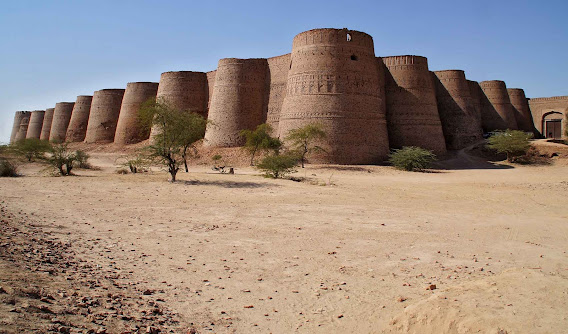
Derawar Fort (Urdu: قِلعہ دراوڑ), is a huge square fortification in Ahmadpur East Tehsil, Punjab, Pakistan. Roughly 130 km south of the city of Bahawalpur, the forty strongholds of Derawar are apparent for some miles in the Cholistan Desert. The dividers have an edge of 1500 meters and confront thirty meters high.

Derawar stronghold was first inherent the ninth century AD by Rai Jajja Bhati, a Hindu Rajput leader of the Bhati clan, as an accolade for Rawal Deoraj Bhati the ruler of Jaisalmer and Bahawalpur.The fortification was at first known as Dera Rawal, and later alluded to as Dera Rawar, which with the progression of opportunity arrived to be articulated Derawar, its present name.

In the eighteenth century, the stronghold was taken over by Muslim Nawabs of Bahawalpur from the Shahotra clan. It was later reconstructed in its present structure in 1732 by the Abbasi ruler Nawab Sadeq Muhammad, yet in 1747 the fortification slipped from their hands attributable to Bahawal Khan's distractions at Shikarpur.

Nawab Mubarak Khan took the fortress back in 1804. 1,000 year-old sling shells were found in the trash almost a rotting divider in the fort. Nawab Sadiq Muhammad Khan Abbasi V, the twelfth and last leader of Bahawalpur State, was brought into the world in the fortification in 1904. This generally huge stronghold presents a tremendous and great construction in the core of the Cholistan desert, however it is quickly weakening and needing prompt preventive measures for protection